I even got my own page and everything!
27 Apr 2011


26 Apr 2011
Summer Sounds
To almost paraphrase Captain Boyle from Sean O'Casey's "Juno and the Paycock", I look up at the sky and ask meself, "What is the sun?" As I look out the window we are in the midst of an unseasonal spell of sunshine. I am currently working my way through the almost 20 minutes of La Dusseldorf's "Cha Cha 2000", a shimmering electronic groovefest driven by Klaus Dinger's trademark motorik beat, and it strikes me that it's perfectly suited to the weather.
In fact, loads of music from the 70s seems to conjure up the sun for me. Perhaps it was the regular heatwaves, or perhaps its just the strange hindsight that renders everybody's childhood shiny and bright, but if it's a beautiful sunny day I find myself inexorably drawn to the music from that wonderful decade. And I don't mean disco (although that, of course, has its place.)
On the other hand, the 1980s for me are characterised by drizzle. And even "Club Tropicana" can't change that. In fact, it actually conjurs up images of sodden espadriles queuing up outside some shady Essex "nite spot", the whiff of hairspray and odour of Bezique heavy in the dreary air.
In fact, loads of music from the 70s seems to conjure up the sun for me. Perhaps it was the regular heatwaves, or perhaps its just the strange hindsight that renders everybody's childhood shiny and bright, but if it's a beautiful sunny day I find myself inexorably drawn to the music from that wonderful decade. And I don't mean disco (although that, of course, has its place.)
On the other hand, the 1980s for me are characterised by drizzle. And even "Club Tropicana" can't change that. In fact, it actually conjurs up images of sodden espadriles queuing up outside some shady Essex "nite spot", the whiff of hairspray and odour of Bezique heavy in the dreary air.
25 Apr 2011
Martin Carthy and Norma Waterson Interview

Interview conducted with Martin Carthy and Norma Waterson, Saturday 3rd August 2002, as they prepared for an appearance at that year's Cambridge Folk Festival.
Neither of you are strangers to the Cambridge Folk Festival. Can you remember the first time you played here?
Norma Waterson I was here at the very first Cambridge festival in 1965. It was small - one stage in a field and a few seats out the front. Paul Simon was on, and the Clancy Brothers. It was a pound to get in.
Martin Carthy I was on the second one and it wasn't much bigger. The first one he had to make a thousand pounds to break even. And he did and that's why it's still going.
NW The thing I really remember was the Clancy Brothers arriving on site in an open top jeep. They roared through the crowd in this open top jeep. Nowadays pop stars would come in on helicopters.
The most obvious change for Cambridge is the size, but do you think the atmosphere of the festival has changed much since the early days?
NW Yes. It's much more populist than it was. It used to be very much a straight folk festival, although it wasn't a traditional one in the sense that you could only get up and do stuff from your own country, but it definitely has got more poppy. But then I think the whole folk scene in general has become much more pop orientated than it was in the 60s.
Do you think people see folk music as a viable career option these days?
NW I think the media have got hold of it. Certainly since we've been singing there have been three or four occasions when nothing's been happening in the charts and someone's realised that there's this thing called traditional music happening - let's have a folk revival! Are there any young and pretty people that we can put pictures in our papers of? It's no bad thing if it gets people interested in folk music, though.
MC It's really bad news for us to be isolated. You get an awful lot of righteousness around, but not a lot of sense. And frequently not a lot of music either!
But neither of you have ever been accused of being purist in any way…
MC I've never really understood what purist meant, honestly, because I don't really know what impure music is.
NW The music in England is a hybrid music anyway. In fact, most of the music in the British Isles is a hybrid - none of it is pure. To go back to pure you're going to have to go back to the ancient Britons.
MC Back to banging rocks…
You're playing with Blue Murder tonight, and there is a definite buzz about your appearance. Expectations are heavy.
NW I hope they're not disappointed!
MC It's very much a band that hits or misses. If it works it's fantastic, but it requires everybody to be on song. There's a lot of chances get taken and a lot of opportunities for falling off the wire, walking into the door and falling over your own feet. But we have a great time.
The way the group started was fairly informal, wasn't it?
NW In the 70s our local school in Robin Hood's Bay was bursting at the seams and needed a new room. We did a concert and all the money went to building this new room. We grabbed as many people as we could. There was Peter Bellamy and Swan Arcade and the Watersons and various other people. We did a concert and we did a few songs together at the end and really liked it.
MC Then in 1987 Iain Anderson asked The Watersons and Swan Arcade to put together a one off concert with an hour's worth of stuff. After the first gig we decided to call ourselves Blue Murder, but the party aspect took over from the music and it fell to bits basically. We had a fantastic time…
NW Rehearsals were very boozy!
MC We started being really industrious then got to talking, telling stories, drinking a bit of wine…
NW …you know, like folkies do.
MC It just got silly, so we gave it up for a while. Then when Jim started up with Lester and Barry we decided to give it another go and it's great fun, it really is. I mean, Barry Coope is a stupendous singer.
Shall you be leaving the boozing until after the gig tonight then?
MC Well, we don't do much of that now. I think 'cos we're older our livers have given up!
NW I think this is about the third time we've been together as Blue Murder. We did the 70s and 80s, but we missed the 90s.
Can we expect another Waterson: Carthy album in the near future?
NW It's finished already, but Tony at Topic didn't want it to clash with the Blue Murder album. You can't flood the shops! We were happy that the Blue Murder album came out first and our album, A Dark Light, comes out in September.
It's been a remarkable couple of years for you, Martin, what with the boxed set, the birthday concert and the honorary doctorate…
MC Yeah, that's astonishing…
…What's the betting on a knighthood?
NW There's no betting. He wouldn't accept it.
MC Knighted folk singers is silly. I mean, knighted rock and rollers is bad enough. Sir Elton John, Sir Cliff Richard… come on lads! To go on from there to knighted folk singers, I mean, what a ridiculous idea. Sir Mick Jagger is bad enough...
NW What would be really nice would be something like the French Legion of Honour, which is just your country recognising you've done something really good. But it's not going to happen in our lifetime.
So what about your solo careers? Can we expect more of that?
MC For the last few years I've been doing an instrumental album, but I'm not entirely happy with doing an entire album of guitar tunes, so it'll probably turn out half and half. I've no idea what I'm going to call it yet.
There's a lot of young talent emerging. When you look to the young talent does it give you hope for the future of the music?
NW Oh, yes. There's some young performers doing some really good stuff. John Boden and John Spiers, they take risks, which is what we did. It doesn't seem risky now, but when the Watersons came along, nobody was singing unaccompanied apart from the traditional singers and people like The Copper Family. We really like it when there's something wild about what the young people do, and there's a few around like that, which is great.
MC The only reservation I had about a lot of the crop of the new singers was that they were all tremendously accomplished and there was not one hint of a risk anywhere, and performing is about risk. But people like Boden and Spiers really are risky. They may make mistakes, but by God, the passion's there, and that makes up for a lot. But they both happen to be very good instrumentalists and very good singers.
NW What I do like is that the young performers specialise in English material. Irish and Scottish material is so lovely, it's easy to go that route, but English songs are weirder, they need more listening to. It really does please us that people have taken that route. It's very exciting.
10 Oct 2010
Just emerged from bed to hear the new Kings of Leon single, which has raised two questions. Firstly, should I have stayed under the covers and secondly, why does every band with pretensions to stadium ubiquity end up sounding like U2?
The Kings seem to have all but disowned their debut album of scratchy garage rock, which is a shame, as its Ethan Johns produced charms, while rough and ready, were certainly more beguiling than their current incarnation as Bono-lite.
In fact, the signature sound of the noughties seems to have been some kind of psuedo striving for profundity provided by a single note bassline and excessive use of a delay pedal, topped with the kind of vocals which suggest big boys stole your lunch money and left you standing bereft in a corner of a primary school toilet holding a melting ice-pop.
Come on, lads. Man up.
14 Oct 2009
Thoughts on Erskine Bridge
There has been a river crossing at Erskine for thousands of years. In the days before the industrial revolution dredged the Clyde and prepared Glasgow for age of the great ships, it was shallow enough to walk across. Later, a small chain pulled ferry navigated the oily waters from its weed slicked slipways on the banks.
When the Erskine Bridge was opened in 1970 by Princess Anne, it became one of the last emblems of the massive campaign of road building which had seen the city of Glasgow carved up by the M8 motorway. Just as the old tenements of Glasgow were crushed beneath the relentless march of progress, so the sleepy river crossing at Erskine became another conduit for the motor car. And in the fields and orchards around began to sprout the new town of Erskine, its council housing and neatly trimmed verges and roundabouts itself a product of Scotland’s post war redevelopment.
It was here, amidst the tidy gardens and white rough cast walls, that I grew up. My bedroom window looked out onto the bridge, which spanned the river in its graceful arc seeming to echo the whaleback curve of the Kilpatrick Hills beyond. At night, the lights on the roadway where strung across the darkness like pearls, while the red lamps on the top of the massive pillars winked at the aircraft gradually slipping into Glasgow airport.
The bridge was our proudest landmark. For years, the town of Erskine was not to be found on any maps, as if its very novelty defied the cartographer’s attention. However, the short spur of the M8 which leapt across the river was. We were a town defined by the bridge. The councillors of Erskine, no doubt keen to forge an identity for their dormitory suburb, incorporated the pattern of approach roads at the bridge’s southern end into the town’s coat of arms. Bargarran primary school, which I began attending in 1976, had incorporated a stylised image of the bridge into its badge, which adorned our neat little grey blazers and schoolbags. When, as a senior pupil at the local High School, I won a competition to design a mural for the local library, the bridge became the central motif in a historical tableau which spanned Viking invasions, 17th Century witch trials and German air raids on the shipyards across the river. In my naïve way, I suppose I was using it as a road into a history for a town which, to most people, didn’t exist except as a road sign on the way to somewhere else.
Of course, such grand social gestures as the building of entirely new towns on green belt have fallen out of favour. It is unlikely that a road scheme on the scale of the Erskine Bridge and its associated approach roads would get the green light these days. In fact, although it dominated our little new town, for many years the bridge was prey to many detractors. From the start, its design was routinely called into question. The designers, Freeman Fox and Partners, were responsible for almost identical West Gate Bridge in Melbourne. As it was nearing completion in 1970, a 112 metre span collapsed, killing 35 workers, a fact my father, with alarming regularity, liked to remind us of when we took the occasional walk over its counterpart in Erskine. As juggernauts thundered past on the four lane car deck, we felt the girders shake and held the railing tight.
The Erskine Bridge’s failure was to be less dramatic. Its cost spiralled out of control; tolls remained in place far longer than anticipated. They were eventually lifted in 2006. The little row of blue toll booths and their cheery occupants disappeared forever, leaving nothing but a windswept plaza through which motorway traffic now sweeps unhindered onto the graceful span. Grass pokes impudent fingers through the cracked cycle track and rust streaks the rails and girders, while down below the vast concrete pillars are scrawled with generations of graffiti. And at night, the red lights still wink at approaching air traffic, over and over and over.
Of course, most people never see the details as they drive across. At this time, they may be vaguely aware of the vast carpet of light from Glasgow upstream, while downstream the Clyde slinks off to the sea between the rolling hills of Renfrewshire and the jagged tooth of Dumbarton rock. It is a lonely place, an odd, transient place where streetlights and headlamps bathe the concrete and the wind whips through the hair. The sad, secret history of Erskine Bridge is hinted at by the phone boxes at either end bearing the numbers of the Samaritans. Even before the double suicide of two unfortunate teenage runaways from a nearby care home, Erskine Bridge had a reputation.
According to some estimates, up to 15 people leap from the bridge each year. From my childhood bedroom, the distant chatter of a hovering helicopter betrayed another tragedy as its searchlight hunted through the darkness. Blue flashing lights would join the yellow and red glow along the span. Once, my family and I watched through binoculars as the police talked a man in from the edge. At school the next day, those of us who lived within sight of the bridge talked of little else and imagined ourselves hanging from the slippery parapet, far above the cold darkness. The playground currency of grim tales permeated our youth and copycats were routinely reprimanded with the accusation that they would jump off “the bridge” if someone told them to do it. Occasionally someone we vaguely knew would. Erskine, although growing rapidly, remained a small community.
To grow up in the shadow of Erskine Bridge was to be constantly aware of its dark secret, even while such events passed unremarked upon by the media. As debate continues about what can be done to prevent such tragedies, it is a grim fact that all high bridges are prone to them. The usual floral tributes are tied to the barriers, and heads shake as we ponder the awful circumstances that drive people to walk out onto the bridge, never to reach the other side. For me, the bridge occupies a place between the glow of a past which promised a better future, and a dark present which has finally, irrevocably, put Erskine on the map at last.
Word Count - 1066
When the Erskine Bridge was opened in 1970 by Princess Anne, it became one of the last emblems of the massive campaign of road building which had seen the city of Glasgow carved up by the M8 motorway. Just as the old tenements of Glasgow were crushed beneath the relentless march of progress, so the sleepy river crossing at Erskine became another conduit for the motor car. And in the fields and orchards around began to sprout the new town of Erskine, its council housing and neatly trimmed verges and roundabouts itself a product of Scotland’s post war redevelopment.
It was here, amidst the tidy gardens and white rough cast walls, that I grew up. My bedroom window looked out onto the bridge, which spanned the river in its graceful arc seeming to echo the whaleback curve of the Kilpatrick Hills beyond. At night, the lights on the roadway where strung across the darkness like pearls, while the red lamps on the top of the massive pillars winked at the aircraft gradually slipping into Glasgow airport.
The bridge was our proudest landmark. For years, the town of Erskine was not to be found on any maps, as if its very novelty defied the cartographer’s attention. However, the short spur of the M8 which leapt across the river was. We were a town defined by the bridge. The councillors of Erskine, no doubt keen to forge an identity for their dormitory suburb, incorporated the pattern of approach roads at the bridge’s southern end into the town’s coat of arms. Bargarran primary school, which I began attending in 1976, had incorporated a stylised image of the bridge into its badge, which adorned our neat little grey blazers and schoolbags. When, as a senior pupil at the local High School, I won a competition to design a mural for the local library, the bridge became the central motif in a historical tableau which spanned Viking invasions, 17th Century witch trials and German air raids on the shipyards across the river. In my naïve way, I suppose I was using it as a road into a history for a town which, to most people, didn’t exist except as a road sign on the way to somewhere else.
Of course, such grand social gestures as the building of entirely new towns on green belt have fallen out of favour. It is unlikely that a road scheme on the scale of the Erskine Bridge and its associated approach roads would get the green light these days. In fact, although it dominated our little new town, for many years the bridge was prey to many detractors. From the start, its design was routinely called into question. The designers, Freeman Fox and Partners, were responsible for almost identical West Gate Bridge in Melbourne. As it was nearing completion in 1970, a 112 metre span collapsed, killing 35 workers, a fact my father, with alarming regularity, liked to remind us of when we took the occasional walk over its counterpart in Erskine. As juggernauts thundered past on the four lane car deck, we felt the girders shake and held the railing tight.
The Erskine Bridge’s failure was to be less dramatic. Its cost spiralled out of control; tolls remained in place far longer than anticipated. They were eventually lifted in 2006. The little row of blue toll booths and their cheery occupants disappeared forever, leaving nothing but a windswept plaza through which motorway traffic now sweeps unhindered onto the graceful span. Grass pokes impudent fingers through the cracked cycle track and rust streaks the rails and girders, while down below the vast concrete pillars are scrawled with generations of graffiti. And at night, the red lights still wink at approaching air traffic, over and over and over.
Of course, most people never see the details as they drive across. At this time, they may be vaguely aware of the vast carpet of light from Glasgow upstream, while downstream the Clyde slinks off to the sea between the rolling hills of Renfrewshire and the jagged tooth of Dumbarton rock. It is a lonely place, an odd, transient place where streetlights and headlamps bathe the concrete and the wind whips through the hair. The sad, secret history of Erskine Bridge is hinted at by the phone boxes at either end bearing the numbers of the Samaritans. Even before the double suicide of two unfortunate teenage runaways from a nearby care home, Erskine Bridge had a reputation.
According to some estimates, up to 15 people leap from the bridge each year. From my childhood bedroom, the distant chatter of a hovering helicopter betrayed another tragedy as its searchlight hunted through the darkness. Blue flashing lights would join the yellow and red glow along the span. Once, my family and I watched through binoculars as the police talked a man in from the edge. At school the next day, those of us who lived within sight of the bridge talked of little else and imagined ourselves hanging from the slippery parapet, far above the cold darkness. The playground currency of grim tales permeated our youth and copycats were routinely reprimanded with the accusation that they would jump off “the bridge” if someone told them to do it. Occasionally someone we vaguely knew would. Erskine, although growing rapidly, remained a small community.
To grow up in the shadow of Erskine Bridge was to be constantly aware of its dark secret, even while such events passed unremarked upon by the media. As debate continues about what can be done to prevent such tragedies, it is a grim fact that all high bridges are prone to them. The usual floral tributes are tied to the barriers, and heads shake as we ponder the awful circumstances that drive people to walk out onto the bridge, never to reach the other side. For me, the bridge occupies a place between the glow of a past which promised a better future, and a dark present which has finally, irrevocably, put Erskine on the map at last.
Word Count - 1066
4 Nov 2007
The Bristol Stool Theory of Music
 This theory is based on sound scientific research and the adoption of complex colo-rectal principles to explain one key fact - why singers sound the way they do. Hitherto, arguments over the relative merits of vocalists have been utterly subjective. In a heroic quest to introduce objectivity into the otherwise utterly opinionated and purely subjective field of music criticism, I propose the adoption of the following classification system - The Bristol Stool Scale Theory of Pop.
Long the preserve of medics to classify bowel movements on what could horrifically be called a "sliding" scale of one to seven (from "Hard to pass and nutlike" to "Entirely liquid"), the Bristol Scale has revealed its true application. Ever since Bruce Springsteen first popped a vein (and, it is rumoured, more) when straining for the high notes during "Glory Days" at Wembley Arena in 1985, this theory has gained in credibilty as the one truly scientific way of classifying rock vocalese.
Springsteen's adoption of black jeans as stage wear after a series of unfortunate incidents led members of his band to start referring to him as "Darkness on the Seat of Brown" showed the validity of this groundbreaking research. In line with established scientific practice, however, we must first establish a control, or benchmark for the scale.
Type One - The Bolton Bullet
 These small, hard and nutlike stools often require straining from the singer, and may even require breath to be held for long periods before expulsion in an outburst of overwrought exasperation. The passee can occasionally turn purple from the effort, and the result often fails to justify the immense emotional outlay involved. The prime example of the Type One vocalist is everyone's favourite mulleteer, Michael Bolton (pictured left, visibly relieved after a successful bout of pebble dashing.) It is said that our Mike could shatter a car windscreen at a distance of half a mile with the powerful ejection of one of his faux soulful putrid pellets.
See also: Barney from Napalm Death.
Type Two - The Lumpy Bruce
 These sausage shaped but lumpy extrusions denote some degree of effort and can occasionally cause visible strain on the face of the afflicted. A prime Type Two stoolee is the originator of the theory, Bruce Springsteen, who can occasionally produce Type Threes or Fours - "The Streets of Philadelphia" was produced after a month long All Bran and banana diet - but is more likely to be found bent forward, heaving like a heifer with a headache.
See also: Joe Cocker
Type Three - The Jaggy Sausage
Type Two - The Lumpy Bruce
These sausage shaped but lumpy extrusions denote some degree of effort and can occasionally cause visible strain on the face of the afflicted. A prime Type Two stoolee is the originator of the theory, Bruce Springsteen, who can occasionally produce Type Threes or Fours - "The Streets of Philadelphia" was produced after a month long All Bran and banana diet - but is more likely to be found bent forward, heaving like a heifer with a headache.See also: Joe Cocker
Type Three
- The Jaggy Sausage
The strain is beginning to show, but not quite to Bruce levels, as we approach this beauty, so called because of its pleasing mass but possession of just a hint of the unpleasant jagginess which can cause furrowing of the brow. The Jaggy Sausage is the preserve of smooth singers with rough edges. Appropriately, spiky haired trollop tickler Rod Stewart is a perfect example - seemingly effortless vocalising but with a throaty rasp offering just a hint of more craggy exertions. Here he can be seen in the perfect position for squeezing out a jaggy jobbie, and he has even wisely worn spandex to allow himself some extra "give", a true sign of a professional at work.
See also: Otis Redding (He's gotta, gotta, gotta!), Frankie Miller, Paul Rogers ("All Right Now" being a prime example of post jag reflection).
See also: Otis Redding (He's gotta, gotta, gotta!), Frankie Miller, Paul Rogers ("All Right Now" being a prime example of post jag reflection).
Type 4 - The Smooth Snake
Truly the Prince of Poos, this perfect specimen glides out with all the ease of a velvet torpedo. Needless to say, it tends to provide a lack of emotional "oomph" or any hint of danger and is the preserve of perfectly fed, balanced diet munching popsters with faultless technique but little understanding of what it means to really suffer. In the late 90s the lack of anything resembling rock action saw a plethora of shining examples of this beige wonder.
Truly the Prince of Poos, this perfect specimen glides out with all the ease of a velvet torpedo. Needless to say, it tends to provide a lack of emotional "oomph" or any hint of danger and is the preserve of perfectly fed, balanced diet munching popsters with faultless technique but little understanding of what it means to really suffer. In the late 90s the lack of anything resembling rock action saw a plethora of shining examples of this beige wonder.
 Fran Healey of Travis can lay claim to one of these, although the undoubted master is Chris Martin of Coldplay, a man so well balanced of bowel that he is often forced to write reminders on his hand to use paper, his ploppers so perfect that he sometimes fails to notice their egress from his apple scented arse. So happy is he with his wonderful toilet habits that it is all he can do to stop himself from "nipping one off" in the most unsuitable of locations, such as here, captured while walking with Gwyneth in Hyde Park and hunkering down to give the ducks a feed they'll never forget. And, given Chris' avowed liking for all things organic and Fairtrade, his eco-turds are often dried, repackaged and available to buy at Coldplay concerts where they bear an uncanny resemblance to Jordan's Fruisli bars.
See also: Bloke from Keane whatever the fuck his name is.
Type Five - The Blurry Blob (or Winehouse)
As we leave the fragrant enamel whiteness of the Martins et al we begin to enter the murky waters of the loose stool brigade. And these waters can get murky. The soft blob presents a pleasing smoothness at first, but hidden behind this facade lurks a world of debauchery and vice of the kind seen in only the more insalubrious of Soho nite-spots. As such, it may appear sweet and innocent at first, but repeated exposure to its ill-formed troubles can lead to rapid deterioration. For this reason, it is sometimes referred to as the Winehouse Stool. Also in this category is mono-limbed folk booze repository John Martyn, who initially gave this stool its original nickname of the "Solid Air".
As we leave the fragrant enamel whiteness of the Martins et al we begin to enter the murky waters of the loose stool brigade. And these waters can get murky. The soft blob presents a pleasing smoothness at first, but hidden behind this facade lurks a world of debauchery and vice of the kind seen in only the more insalubrious of Soho nite-spots. As such, it may appear sweet and innocent at first, but repeated exposure to its ill-formed troubles can lead to rapid deterioration. For this reason, it is sometimes referred to as the Winehouse Stool. Also in this category is mono-limbed folk booze repository John Martyn, who initially gave this stool its original nickname of the "Solid Air".
Vowels will begin to blur, words will lose definition even as the music remains perfectly sculpted, and before you know it incontinence and shambolic mutterings are all that is left. It marks the start of a slippery slope downhill towards the foul depths of...
Type Six - The Monster Mush
Singers fitting this profile have started to lose coherence in a large wa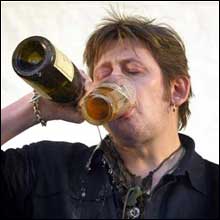 y. What in the previous type had seemed on occasion to be a pleasing smoothness has now been surpassed by an ill-formed mess which frequently borders on the incoherent and downright slimy. A great exponent of the "mush" is Shane MacGowan, whose vowels have blended into a foul smelling miasma of Martini and Malboros and who pours out his words with the splattering profligacy of the truly inspired. Unfortunately, such is the stench created by this mushy horror that few people can make out the profundity through the intestinal fug. Rapidly bringing up the rear (so to speak) is trainee musher Pete Doherty, who rumour has it is preparing to move in with Shane to better share fluffy tips.
Singers fitting this profile have started to lose coherence in a large wa
y. What in the previous type had seemed on occasion to be a pleasing smoothness has now been surpassed by an ill-formed mess which frequently borders on the incoherent and downright slimy. A great exponent of the "mush" is Shane MacGowan, whose vowels have blended into a foul smelling miasma of Martini and Malboros and who pours out his words with the splattering profligacy of the truly inspired. Unfortunately, such is the stench created by this mushy horror that few people can make out the profundity through the intestinal fug. Rapidly bringing up the rear (so to speak) is trainee musher Pete Doherty, who rumour has it is preparing to move in with Shane to better share fluffy tips.
Type Seven - The Liquid Launch
In an almost Neitzchean coup, Liquid Launchers have passed beyond Good and Evil into a realm of almost transcendent toilet habit. Effortless, floating and possessed of so little gravity that their vocalising cannot truly be called solid in any way, such singers are epitmosed by porky androgyne Anthony Hegarty (of Johnsons fame), a man whose vocals are so liquid that they barely have time to form before they dissolve into soft clouds of fragrant liquidity. Originally, his breakthrough album was to have been called "I Am a Turd Now" but sharp eyed observers pointed out to him that this would represent wishful thinking of the highest order, and redirected him to something more suitably weightless. Here he can be seen lurking behind Jo Whiley (as yet un-rated on the Bristol Scale) in case someone should pass him an oat cake and disrupt his carefully cultivated looseness.
In an almost Neitzchean coup, Liquid Launchers have passed beyond Good and Evil into a realm of almost transcendent toilet habit. Effortless, floating and possessed of so little gravity that their vocalising cannot truly be called solid in any way, such singers are
epitmosed by porky androgyne Anthony Hegarty (of Johnsons fame), a man whose vocals are so liquid that they barely have time to form before they dissolve into soft clouds of fragrant liquidity. Originally, his breakthrough album was to have been called "I Am a Turd Now" but sharp eyed observers pointed out to him that this would represent wishful thinking of the highest order, and redirected him to something more suitably weightless. Here he can be seen lurking behind Jo Whiley (as yet un-rated on the Bristol Scale) in case someone should pass him an oat cake and disrupt his carefully cultivated looseness.
Subscribe to:
Posts (Atom)