 This theory is based on sound scientific research and the adoption of complex colo-rectal principles to explain one key fact - why singers sound the way they do. Hitherto, arguments over the relative merits of vocalists have been utterly subjective. In a heroic quest to introduce objectivity into the otherwise utterly opinionated and purely subjective field of music criticism, I propose the adoption of the following classification system - The Bristol Stool Scale Theory of Pop.
Long the preserve of medics to classify bowel movements on what could horrifically be called a "sliding" scale of one to seven (from "Hard to pass and nutlike" to "Entirely liquid"), the Bristol Scale has revealed its true application. Ever since Bruce Springsteen first popped a vein (and, it is rumoured, more) when straining for the high notes during "Glory Days" at Wembley Arena in 1985, this theory has gained in credibilty as the one truly scientific way of classifying rock vocalese.
Springsteen's adoption of black jeans as stage wear after a series of unfortunate incidents led members of his band to start referring to him as "Darkness on the Seat of Brown" showed the validity of this groundbreaking research. In line with established scientific practice, however, we must first establish a control, or benchmark for the scale.
Type One - The Bolton Bullet
 These small, hard and nutlike stools often require straining from the singer, and may even require breath to be held for long periods before expulsion in an outburst of overwrought exasperation. The passee can occasionally turn purple from the effort, and the result often fails to justify the immense emotional outlay involved. The prime example of the Type One vocalist is everyone's favourite mulleteer, Michael Bolton (pictured left, visibly relieved after a successful bout of pebble dashing.) It is said that our Mike could shatter a car windscreen at a distance of half a mile with the powerful ejection of one of his faux soulful putrid pellets.
See also: Barney from Napalm Death.
Type Two - The Lumpy Bruce
 These sausage shaped but lumpy extrusions denote some degree of effort and can occasionally cause visible strain on the face of the afflicted. A prime Type Two stoolee is the originator of the theory, Bruce Springsteen, who can occasionally produce Type Threes or Fours - "The Streets of Philadelphia" was produced after a month long All Bran and banana diet - but is more likely to be found bent forward, heaving like a heifer with a headache.
See also: Joe Cocker
Type Three - The Jaggy Sausage
Type Two - The Lumpy Bruce
 These sausage shaped but lumpy extrusions denote some degree of effort and can occasionally cause visible strain on the face of the afflicted. A prime Type Two stoolee is the originator of the theory, Bruce Springsteen, who can occasionally produce Type Threes or Fours - "The Streets of Philadelphia" was produced after a month long All Bran and banana diet - but is more likely to be found bent forward, heaving like a heifer with a headache.
See also: Joe Cocker
Type Three
 - The Jaggy Sausage
The strain is beginning to show, but not quite to Bruce levels, as we approach this beauty, so called because of its pleasing mass but possession of just a hint of the unpleasant jagginess which can cause furrowing of the brow. The Jaggy Sausage is the preserve of smooth singers with rough edges. Appropriately, spiky haired trollop tickler Rod Stewart is a perfect example - seemingly effortless vocalising but with a throaty rasp offering just a hint of more craggy exertions. Here he can be seen in the perfect position for squeezing out a jaggy jobbie, and he has even wisely worn spandex to allow himself some extra "give", a true sign of a professional at work.
See also: Otis Redding (He's gotta, gotta, gotta!), Frankie Miller, Paul Rogers ("All Right Now" being a prime example of post jag reflection).
See also: Otis Redding (He's gotta, gotta, gotta!), Frankie Miller, Paul Rogers ("All Right Now" being a prime example of post jag reflection).
Type 4 - The Smooth Snake
Truly the Prince of Poos, this perfect specimen glides out with all the ease of a velvet torpedo. Needless to say, it tends to provide a lack of emotional "oomph" or any hint of danger and is the preserve of perfectly fed, balanced diet munching popsters with faultless technique but little understanding of what it means to really suffer. In the late 90s the lack of anything resembling rock action saw a plethora of shining examples of this beige wonder.
Truly the Prince of Poos, this perfect specimen glides out with all the ease of a velvet torpedo. Needless to say, it tends to provide a lack of emotional "oomph" or any hint of danger and is the preserve of perfectly fed, balanced diet munching popsters with faultless technique but little understanding of what it means to really suffer. In the late 90s the lack of anything resembling rock action saw a plethora of shining examples of this beige wonder.
 Fran Healey of Travis can lay claim to one of these, although the undoubted master is Chris Martin of Coldplay, a man so well balanced of bowel that he is often forced to write reminders on his hand to use paper, his ploppers so perfect that he sometimes fails to notice their egress from his apple scented arse. So happy is he with his wonderful toilet habits that it is all he can do to stop himself from "nipping one off" in the most unsuitable of locations, such as here, captured while walking with Gwyneth in Hyde Park and hunkering down to give the ducks a feed they'll never forget. And, given Chris' avowed liking for all things organic and Fairtrade, his eco-turds are often dried, repackaged and available to buy at Coldplay concerts where they bear an uncanny resemblance to Jordan's Fruisli bars.
See also: Bloke from Keane whatever the fuck his name is.
Type Five - The Blurry Blob (or Winehouse)
As we leave the fragrant enamel whiteness of the Martins et al we begin to enter the murky waters of the loose stool brigade. And these waters can get murky. The soft blob presents a pleasing smoothness at first, but hidden behind this facade lurks a world of debauchery and vice of the kind seen in only the more insalubrious of Soho nite-spots. As such, it may appear sweet and innocent at first, but repeated exposure to its ill-formed troubles can lead to rapid deterioration. For this reason, it is sometimes referred to as the Winehouse Stool. Also in this category is mono-limbed folk booze repository John Martyn, who initially gave this stool its original nickname of the "Solid Air".
As we leave the fragrant enamel whiteness of the Martins et al we begin to enter the murky waters of the loose stool brigade. And these waters can get murky. The soft blob presents a pleasing smoothness at first, but hidden behind this facade lurks a world of debauchery and vice of the kind seen in only the more insalubrious of Soho nite-spots. As such, it may appear sweet and innocent at first, but repeated exposure to its ill-formed troubles can lead to rapid deterioration. For this reason, it is sometimes referred to as the Winehouse Stool. Also in this category is mono-limbed folk booze repository John Martyn, who initially gave this stool its original nickname of the "Solid Air".
Vowels will begin to blur, words will lose definition even as the music remains perfectly sculpted, and before you know it incontinence and shambolic mutterings are all that is left. It marks the start of a slippery slope downhill towards the foul depths of...
Type Six - The Monster Mush
Singers fitting this profile have started to lose coherence in a large wa y. What in the previous type had seemed on occasion to be a pleasing smoothness has now been surpassed by an ill-formed mess which frequently borders on the incoherent and downright slimy. A great exponent of the "mush" is Shane MacGowan, whose vowels have blended into a foul smelling miasma of Martini and Malboros and who pours out his words with the splattering profligacy of the truly inspired. Unfortunately, such is the stench created by this mushy horror that few people can make out the profundity through the intestinal fug. Rapidly bringing up the rear (so to speak) is trainee musher Pete Doherty, who rumour has it is preparing to move in with Shane to better share fluffy tips.
Singers fitting this profile have started to lose coherence in a large wa
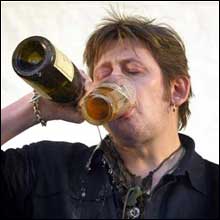 y. What in the previous type had seemed on occasion to be a pleasing smoothness has now been surpassed by an ill-formed mess which frequently borders on the incoherent and downright slimy. A great exponent of the "mush" is Shane MacGowan, whose vowels have blended into a foul smelling miasma of Martini and Malboros and who pours out his words with the splattering profligacy of the truly inspired. Unfortunately, such is the stench created by this mushy horror that few people can make out the profundity through the intestinal fug. Rapidly bringing up the rear (so to speak) is trainee musher Pete Doherty, who rumour has it is preparing to move in with Shane to better share fluffy tips.
Type Seven - The Liquid Launch
In an almost Neitzchean coup, Liquid Launchers have passed beyond Good and Evil into a realm of almost transcendent toilet habit. Effortless, floating and possessed of so little gravity that their vocalising cannot truly be called solid in any way, such singers are epitmosed by porky androgyne Anthony Hegarty (of Johnsons fame), a man whose vocals are so liquid that they barely have time to form before they dissolve into soft clouds of fragrant liquidity. Originally, his breakthrough album was to have been called "I Am a Turd Now" but sharp eyed observers pointed out to him that this would represent wishful thinking of the highest order, and redirected him to something more suitably weightless. Here he can be seen lurking behind Jo Whiley (as yet un-rated on the Bristol Scale) in case someone should pass him an oat cake and disrupt his carefully cultivated looseness.
In an almost Neitzchean coup, Liquid Launchers have passed beyond Good and Evil into a realm of almost transcendent toilet habit. Effortless, floating and possessed of so little gravity that their vocalising cannot truly be called solid in any way, such singers are
 epitmosed by porky androgyne Anthony Hegarty (of Johnsons fame), a man whose vocals are so liquid that they barely have time to form before they dissolve into soft clouds of fragrant liquidity. Originally, his breakthrough album was to have been called "I Am a Turd Now" but sharp eyed observers pointed out to him that this would represent wishful thinking of the highest order, and redirected him to something more suitably weightless. Here he can be seen lurking behind Jo Whiley (as yet un-rated on the Bristol Scale) in case someone should pass him an oat cake and disrupt his carefully cultivated looseness.


